
One of the first questions business owners ask when considering professional bookkeeping is simple:
How much does a bookkeeper cost?
The answer depends on the business.
Some businesses have a few dozen transactions each month. Others have multiple bank accounts, credit cards, employees, GST filings, loans and hundreds of transactions.
That means two businesses with similar revenue can require very different amounts of bookkeeping work.
Here's a practical look at what bookkeeping costs in Vancouver and what actually determines the price.
How Much Does Bookkeeping Cost in Vancouver?
Bookkeeping services are commonly priced using an hourly rate, a fixed monthly fee or a fixed annual fee.
Hourly rates vary depending on the experience of the bookkeeper and the type of work being performed.
Fixed-fee bookkeeping has also become increasingly common because it gives business owners a predictable cost and allows the bookkeeping firm to price the work based on the overall requirements of the business.
For a relatively straightforward small business, bookkeeping may cost a few hundred dollars per month.
More active or complex businesses can cost considerably more.
The important question isn't simply what a bookkeeper charges.
It's what work needs to be done for your particular business.
What Affects the Cost of Bookkeeping?
Several factors have a much greater impact on bookkeeping cost than revenue alone.
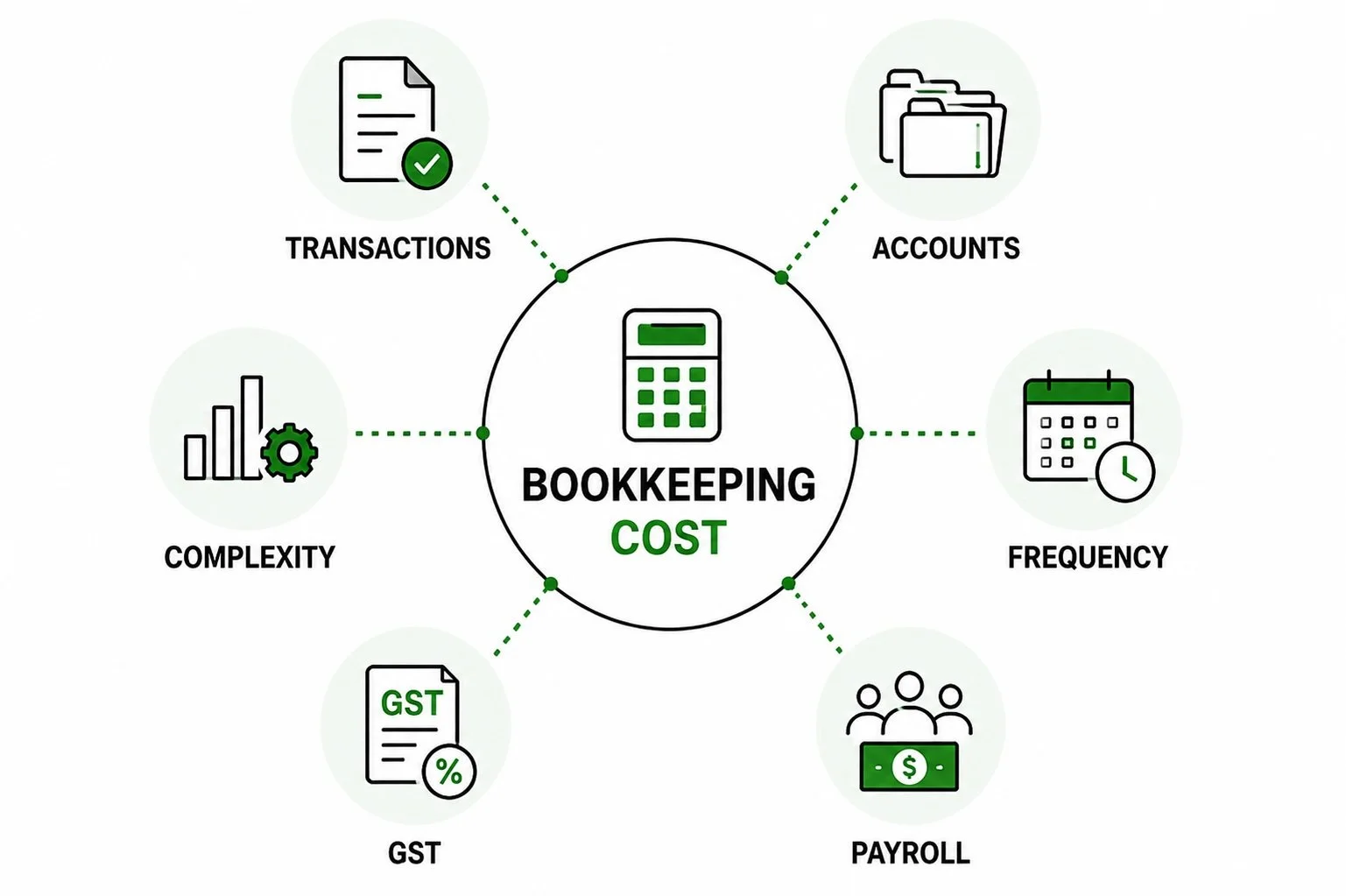
Number of Transactions
Transaction volume is one of the most obvious factors.
A business processing 40 transactions each month generally requires less bookkeeping work than one processing 400.
But volume isn't the only consideration.
Forty complicated transactions can sometimes require more work than hundreds of simple, repetitive transactions.
Number of Bank and Credit Card Accounts
Every bank account and credit card needs to be recorded and reconciled.
A business operating through one bank account and one credit card is generally simpler to maintain than a business using several accounts, multiple credit cards, lines of credit and payment processors.
Bookkeeping Frequency
How often the books are completed also affects the service and the price.
Some businesses only require annual bookkeeping.
Others may need quarterly service.
Established businesses often prefer monthly bookkeeping so their records remain current throughout the year.
More frequent service generally involves more ongoing work and communication, but it also gives the business owner more timely financial information.
Payroll
Businesses with employees typically require additional bookkeeping.
Payroll can involve:
Recording payroll transactions
Tracking payroll liabilities
Reconciling payroll accounts
Recording source deductions
Dealing with payroll-related adjustments
The complexity increases as the number of employees and payroll activity grows.
GST
GST adds another layer to the bookkeeping.
Once a business is registered, the books need to properly track GST collected from customers and eligible GST paid on business expenses.
The bookkeeping should also support the GST returns being filed with the CRA.
Complexity
Some businesses are simply more complicated than others.
A business may have:
Multiple revenue streams
Loans
Equipment purchases
Shareholder transactions
Contractor payments
Foreign currency transactions
Multiple payment processors
Significant accounts receivable
Significant accounts payable
These things don't necessarily make a business difficult to manage, but they can increase the bookkeeping work required.
Does Business Revenue Determine Bookkeeping Cost?
Not necessarily.
Revenue tells you how much money a business generates. It doesn't tell you how much bookkeeping is involved.
Consider two businesses that each generate $500,000 per year.
One might be a consultant who sends a handful of invoices each month and has relatively few expenses.
The other might employ several people, use multiple credit cards, process hundreds of transactions and collect payments through several platforms.
Their revenue is identical.
Their bookkeeping requirements are not.
That's why transaction volume and complexity are usually more useful pricing factors than revenue alone.
Hourly vs. Fixed-Fee Bookkeeping
There are advantages to both pricing models.
Hourly Bookkeeping
With hourly bookkeeping, you pay for the amount of time required to complete the work.
This can make sense when the scope is uncertain or when a business only needs occasional help.
The downside is that the final cost can be less predictable.
Fixed-Fee Bookkeeping
With fixed-fee bookkeeping, the expected work is reviewed in advance and a regular price is established.
This gives the business owner more predictable costs.
It also shifts the conversation away from how many hours were spent and toward what needs to be completed.
Neither approach is automatically better.
What matters is understanding what's included.
What Should Be Included in the Price?
When comparing bookkeeping services, the monthly or annual fee doesn't tell you very much on its own.
You need to know what you're actually receiving.
Depending on the service, the price may include:
Transaction categorization
Bank reconciliations
Credit card reconciliations
GST tracking
Financial reports
Payroll recording
Accounts receivable
Accounts payable
Year-end preparation
Communication with your accountant
Ongoing questions and support
Two bookkeeping quotes can look very different while actually covering very different scopes of work.
Why the Cheapest Bookkeeping Isn't Always the Cheapest
Bookkeeping and accounting are connected.
If the bookkeeping isn't complete or accurate, someone eventually has to fix it.
That may happen during the year.
Or it may happen when the accountant receives the books at year-end.
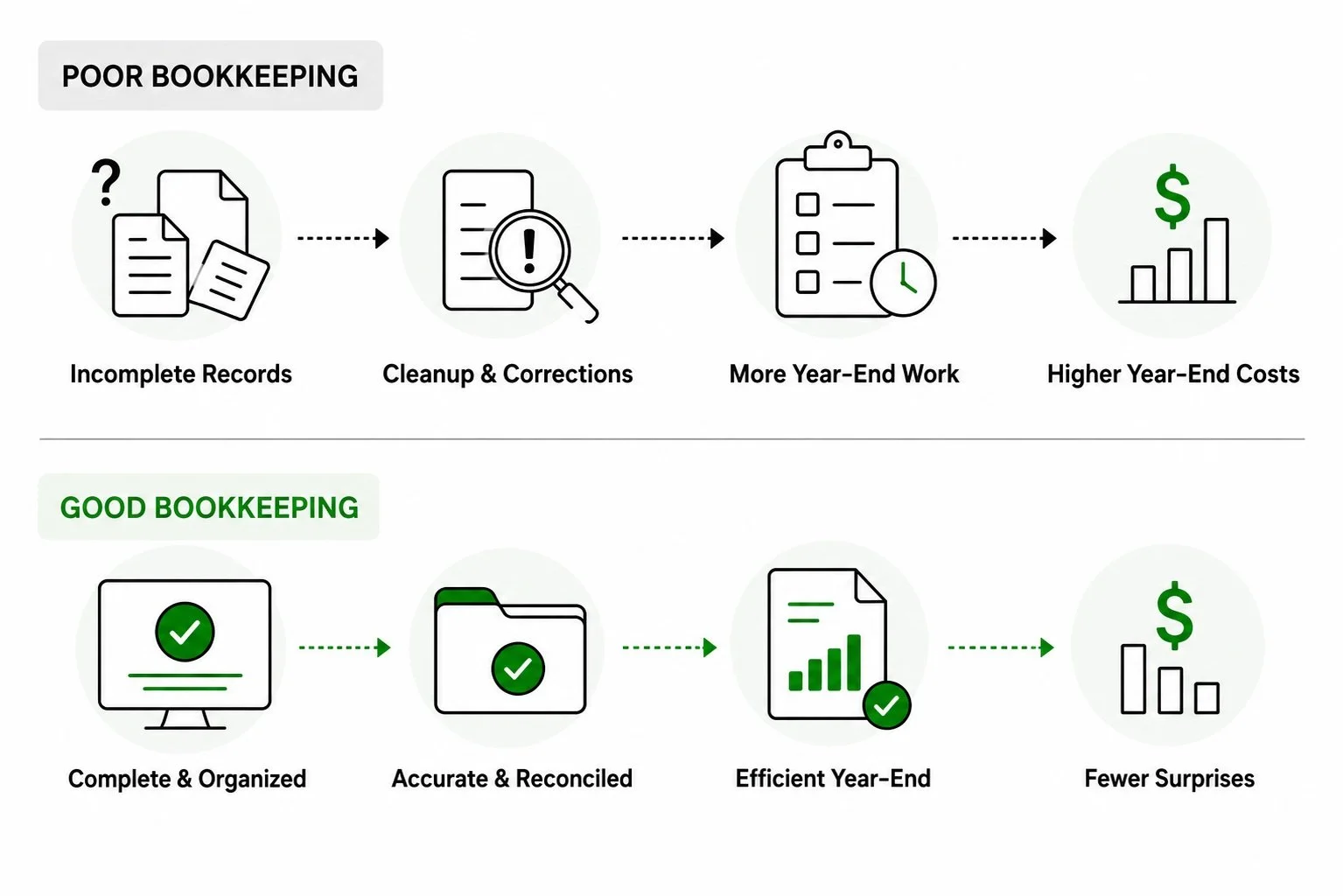
Missing transactions, unreconciled accounts and incorrect classifications can all create additional work.
That work still has to be paid for.
Good bookkeeping can reduce the amount of cleanup and correction required later and make the year-end accounting process much smoother.
That doesn't mean the most expensive bookkeeper is automatically the best choice either.
The goal is to find the right combination of accuracy, service, scope and price.
What About Cheap Online Bookkeeping Services?
Technology has created many lower-cost bookkeeping options.
For some businesses, these services can work perfectly well.
The question is how much support you need.
If your business is simple and you're comfortable handling questions yourself, a highly automated service may be enough.
If your business has more complexity, you may value being able to speak with someone who understands your books and your business.
Price matters.
But so do accessibility, continuity and understanding.
How Much Should a Small Business Spend on Bookkeeping?
There isn't a percentage of revenue that every business should spend.
Instead, think about what the bookkeeping is accomplishing.
At a minimum, your books should:
Be accurate
Be reconciled
Track your tax obligations
Support your year-end accounting
Give you useful financial information
Be completed when you need them
The right cost is the amount required to accomplish those things without paying for services your business doesn't need.
Can You Save Money by Doing Some of the Work Yourself?
Sometimes.
Keeping your business and personal transactions separate is one of the easiest ways to reduce unnecessary bookkeeping work.
You can also help by:
Using dedicated business bank and credit card accounts
Keeping receipts and supporting documents organized
Responding to bookkeeping questions promptly
Avoiding unnecessary accounts and payment methods
Keeping invoicing organized
Maintaining consistent business processes
The cleaner the information going into the bookkeeping system, the easier the bookkeeping usually becomes.
What Does xBooks Charge?
At xBooks, pricing depends on the size and complexity of the business and how frequently the bookkeeping needs to be completed.
Our bookkeeping services currently start at:
Sole Proprietors — from $200/month
Corporations — from $250/month
Those are starting prices rather than packages that fit every business.
Before providing a price, we look at how the business operates, the number of accounts and transactions, the bookkeeping frequency and any additional requirements.
The goal is to understand the work first and then provide a clear price for the service required.
What Should You Ask Before Hiring a Bookkeeper?
Price should be part of the conversation, but it shouldn't be the only question.
Consider asking:
What's included in the price?
How often will my bookkeeping be completed?
Will my bank and credit card accounts be reconciled?
Is GST included?
Who will I communicate with?
Will I receive financial reports?
What happens at year-end?
Will you work with my accountant?
Are there additional charges I should expect?
A good bookkeeping relationship should make your financial administration simpler, not create more uncertainty.
Frequently Asked Questions
-
Hourly rates vary considerably depending on experience, the type of bookkeeping being performed and the complexity of the business. Many bookkeeping firms now use fixed monthly or annual pricing instead of hourly billing.
-
For established businesses, monthly bookkeeping can be valuable because it keeps financial records current, catches problems earlier and provides more useful financial information throughout the year.
-
Professional bookkeeping and accounting fees incurred for business purposes are generally deductible business expenses, subject to the normal rules governing business deductions.
-
Yes. Many business owners handle their own bookkeeping, particularly when the business is new or relatively simple. As the business grows, the time involved and the complexity of the accounting often make professional bookkeeping more worthwhile.
-
Transaction volume, number of accounts, payroll, GST, bookkeeping frequency, complexity and the level of support provided can all affect the amount of work required.
Bookkeeping Services in Vancouver
At xBooks, we provide bookkeeping, accounting and tax support for service-based businesses in Vancouver and the Lower Mainland.
We work with both sole proprietors and corporations, with support ranging from annual bookkeeping to ongoing monthly service.
If your bookkeeping is behind, we can also help bring it up to date before moving into an ongoing service.
Want to know what bookkeeping would cost for your business? Book a call with xBooks and we'll take a look at what you need.