
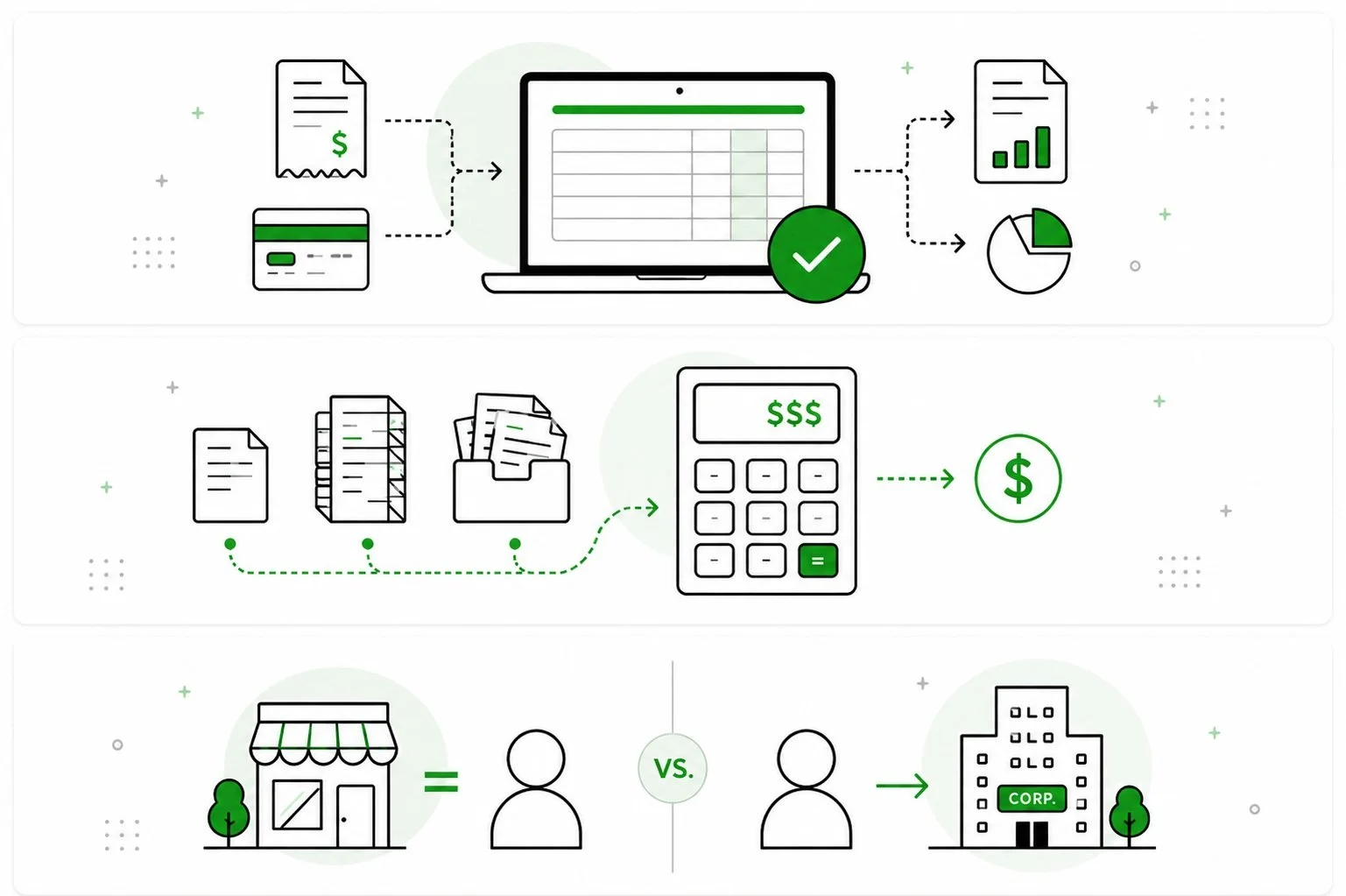
Running a business means keeping track of a lot more than sales and expenses.
Your bookkeeping affects your tax returns, GST filings, financial statements and your ability to understand how your business is actually performing.
Yet many small business owners aren't quite sure what their bookkeeping should include—or whether they're doing enough.
Here's a practical look at small business bookkeeping in British Columbia and what you should expect from a good bookkeeping system.
What Is Bookkeeping?
Bookkeeping is the process of recording and organizing the financial activity of your business.
That includes money coming in, money going out and transactions involving things your business owns or owes.
Depending on the business, bookkeeping can include:
Recording income and expenses
Categorizing transactions
Reconciling bank and credit card accounts
Tracking accounts receivable
Tracking accounts payable
Recording payroll
Tracking GST
Recording loans and financing
Recording equipment and other asset purchases
Preparing financial reports
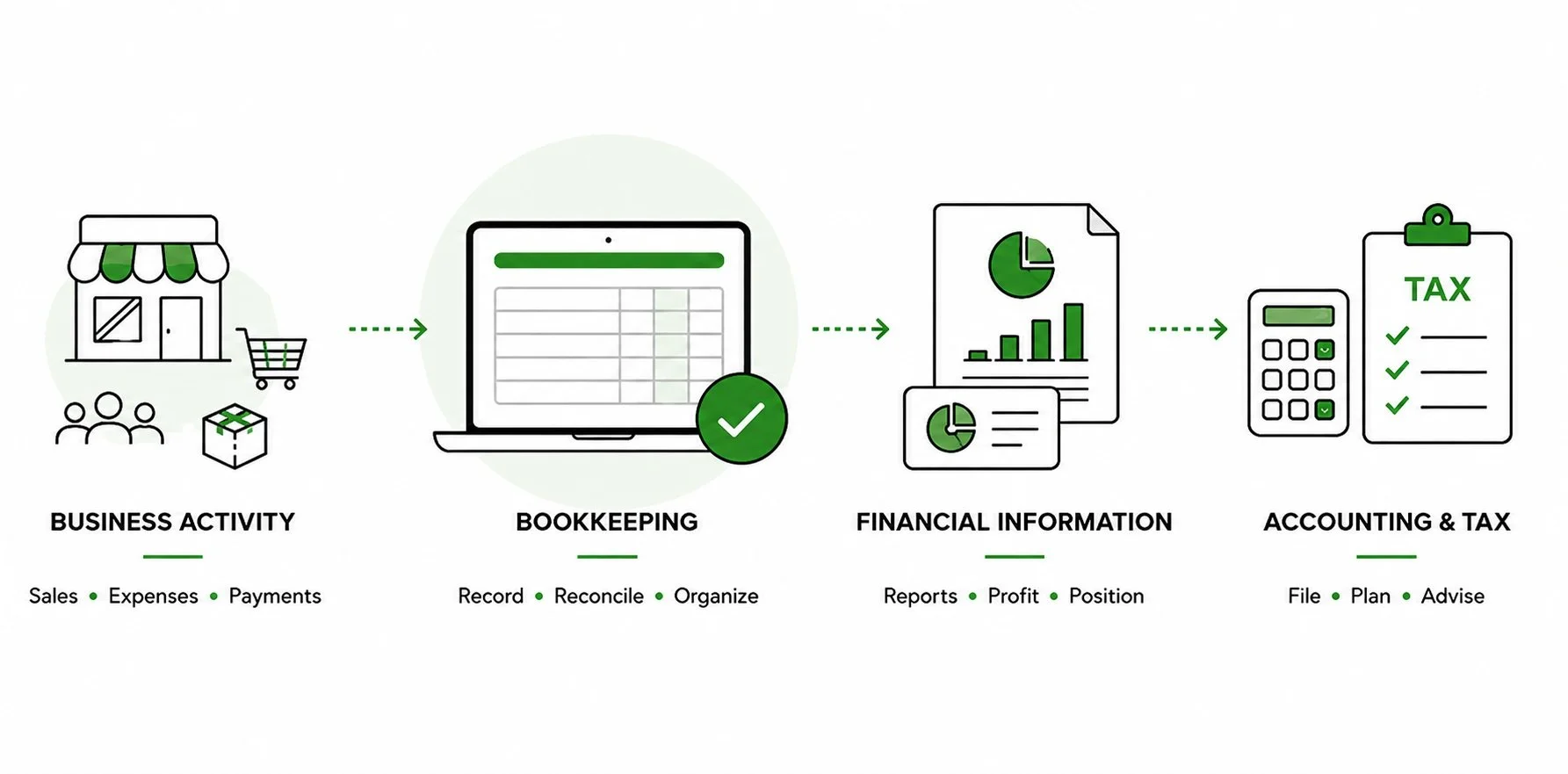
Good bookkeeping creates the financial records that your accountant eventually relies on to prepare your year-end financial information and tax returns.
Why Good Bookkeeping Matters
For many business owners, bookkeeping starts as a tax requirement.
That's certainly part of it.
But once a business becomes established, good bookkeeping serves a much bigger purpose.
You know how your business is performing
Your bank balance doesn't tell you whether your business is profitable.
Accurate books allow you to see your revenue, expenses and profit and compare results over time.
Tax filing becomes easier
When your bookkeeping is complete and accurate, your accountant has much better information to work with at year-end.
That means fewer questions, fewer corrections and less time spent reconstructing transactions months after they occurred.
You can see problems earlier
Bookkeeping can reveal things that are difficult to notice from your bank account alone.
Expenses may be increasing.
Customers may be taking longer to pay.
Margins may be shrinking.
GST may be accumulating faster than expected.
The sooner you see those things, the sooner you can deal with them.
What Records Does a BC Business Need to Keep?
Canadian businesses are required to maintain records that support their income, expenses and tax obligations.
Depending on your business, these can include:
Sales invoices
Purchase invoices
Receipts
Bank statements
Credit card statements
Deposit information
Contracts
Payroll records
GST records
Accounting records and ledgers
Tax returns and supporting calculations
Electronic records are acceptable, but they still need to be organized and accessible.
In most cases, business and tax records need to be retained for at least six years.
That doesn't mean you need boxes of paper.
Many businesses now maintain almost everything electronically. The important thing is having a reliable system so documents can be found when they're needed.
Keep Business and Personal Spending Separate
One of the simplest ways to improve your bookkeeping is to separate business and personal transactions.
Ideally, your business should have its own bank account and credit card.
When everything runs through the same accounts, bookkeeping becomes more difficult because every transaction needs to be reviewed to determine whether it was business or personal.
For corporations, separation is particularly important because the corporation is a separate legal entity from its shareholders.
Even as a sole proprietor, keeping separate accounts makes the bookkeeping significantly cleaner.
Bank Reconciliations Are Essential
Recording transactions is only part of bookkeeping.
Your accounts should also be reconciled.
A bank reconciliation compares the transactions in your accounting records with the transactions appearing on your bank statement.
If they don't agree, you need to determine why.
There may be:
Missing transactions
Duplicate entries
Incorrect amounts
Transactions posted to the wrong account
Payments that haven't cleared
Deposits recorded incorrectly
Without reconciliations, books can appear complete while still containing significant errors.
How Often Should Bookkeeping Be Done?
There isn't one answer for every business.
The appropriate frequency depends on how active and complex the business is.
Annual bookkeeping
Some very small businesses with relatively few transactions may only need their books completed annually.
Quarterly bookkeeping
Quarterly bookkeeping can work for businesses with moderate activity that don't require monthly financial information.
It can also line up well with quarterly GST reporting.
Monthly bookkeeping
Monthly bookkeeping generally makes more sense as a business becomes larger or more active.
It keeps the books current and makes it much easier to identify problems before year-end.
For an established service business, monthly bookkeeping often provides a good balance between cost and useful financial information.
How Does GST Fit Into Your Bookkeeping?
GST should be built into your bookkeeping rather than treated as a completely separate job.
Most businesses must register for GST once they are no longer considered a small supplier under CRA rules.
For most businesses, the small-supplier threshold is $30,000 in worldwide taxable supplies. The timing of mandatory registration depends on whether you exceed that amount in a single calendar quarter or over consecutive calendar quarters.
Once registered, your bookkeeping should track:
GST collected from customers
GST paid on eligible business purchases
Input tax credits
GST owing to or refundable from the CRA
Waiting until the GST return is due to figure all of this out can create unnecessary work.
What Financial Reports Should You Look At?
You don't need to become an accountant to understand your business.
Two reports are particularly useful.
Profit and Loss Statement
Sometimes called an income statement, this report shows your revenue and expenses over a particular period.
It answers the basic question:
Did the business make money?
It can also help you see where the money is going.
Balance Sheet
Your balance sheet shows what the business owns and owes at a particular point in time.
That can include:
Cash
Accounts receivable
Equipment
Credit cards
Loans
GST payable
Amounts owing to or from shareholders
The balance sheet is also where many bookkeeping problems become visible.
Bookkeeping vs. Accounting: What's the Difference?
The two overlap, but they're not exactly the same.
Bookkeeping focuses primarily on maintaining the financial records of the business.
Accounting uses those records to prepare financial information, make year-end adjustments, prepare tax returns and provide broader financial or tax advice.
The problem arises when the two are treated as completely unrelated.
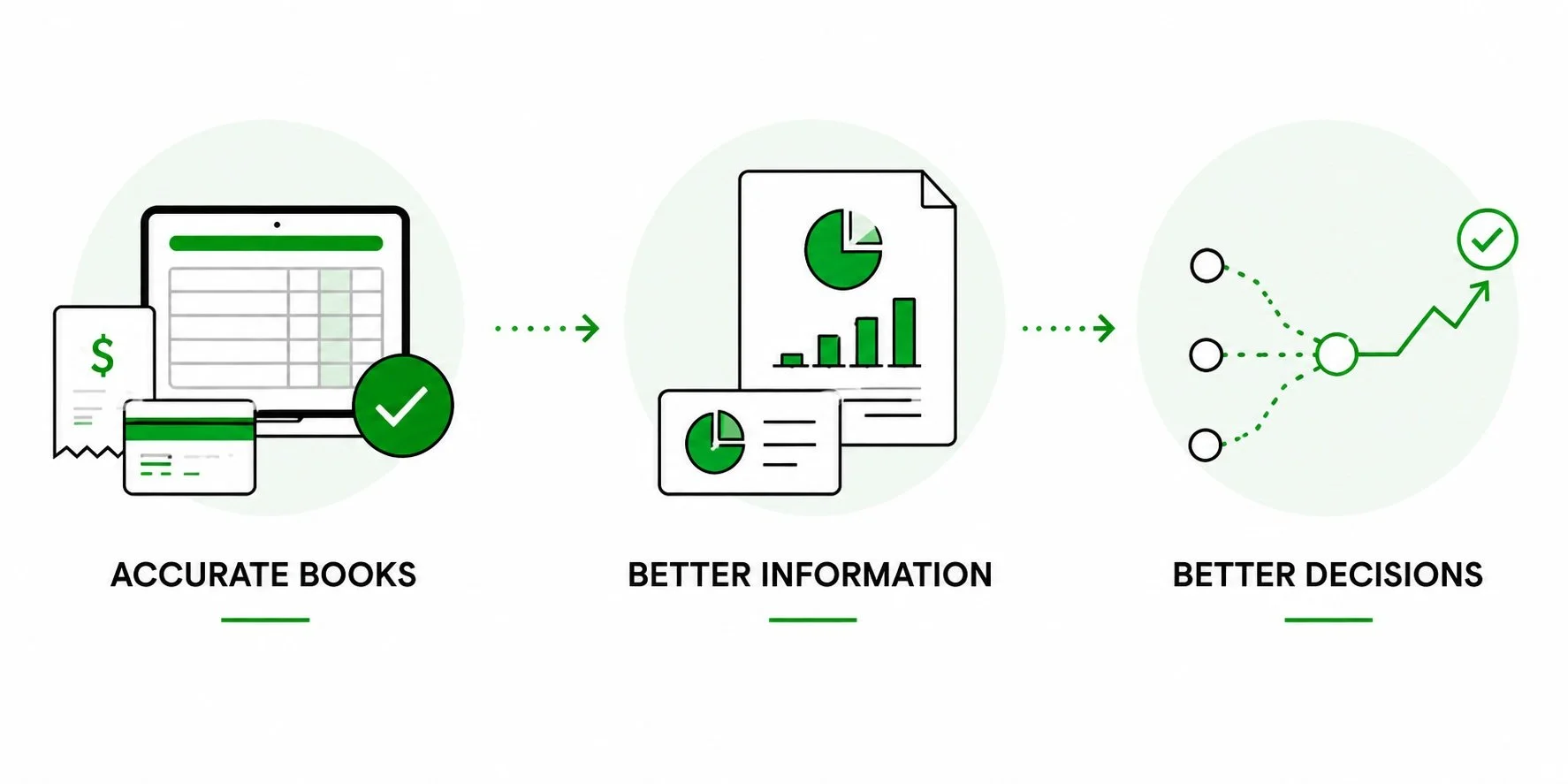
Poor bookkeeping creates more accounting work.
Good bookkeeping makes accounting easier.
That's why there is value in having your bookkeeping done with year-end accounting and tax requirements in mind.
Can You Do Your Own Bookkeeping?
Absolutely.
Accounting software has made bookkeeping much more accessible to business owners.
For a new or relatively simple business, doing it yourself may make sense.
The question changes as the business grows.
Eventually, you have to consider:
How much time you're spending on bookkeeping
Whether the books are actually accurate
Whether you're keeping up with reconciliations
Whether GST is being handled correctly
Whether your accountant is making significant corrections at year-end
Whether your time would be better spent running the business
Doing your own bookkeeping isn't free if it consumes hours that could have been spent on your business.
When Should You Hire a Bookkeeper?
There isn't a particular revenue number where every business suddenly needs a bookkeeper.
But there are some common signs.
Your bookkeeping is consistently behind.
You're not confident the numbers are correct.
You're spending evenings or weekends trying to catch up.
Your accountant makes numerous corrections every year.
You're unsure how much GST you owe.
You can't easily tell how profitable the business is.
Or you've simply reached the point where doing the books isn't a good use of your time anymore.
That's usually when professional bookkeeping starts becoming valuable.
What Should You Expect From a Bookkeeper?
A good bookkeeper should do more than enter transactions into accounting software.
You should expect:
Accurate records
Reconciled accounts
Consistent categorization
Proper GST tracking
Organized supporting documentation
Useful financial reports
Clear communication
Books that are ready for your accountant and tax return
You should also be able to ask questions.
Small business accounting can become unnecessarily complicated. Part of good service is being able to explain what's happening in language you understand.
Frequently Asked Questions
-
No. You can maintain your own books as long as you maintain adequate records and meet your tax obligations. Many businesses hire a bookkeeper because of the time involved and the value of having accurate, professionally maintained records.
-
In most cases, the CRA requires records and supporting documents to be kept for six years from the end of the last tax year they relate to. Some records may need to be kept longer.
-
It's not mandatory, but accounting software can make bookkeeping considerably easier, particularly once a business has regular activity, GST reporting or multiple accounts.
-
Not necessarily. The right frequency depends on the size and complexity of your business. Smaller businesses may be fine with annual or quarterly bookkeeping, while established businesses often benefit from monthly bookkeeping.
-
Professional accounting and bookkeeping fees incurred for business purposes are generally business expenses, subject to the normal tax rules governing deductible expenses.
Bookkeeping Support for Vancouver Businesses
At xBooks, we provide bookkeeping, accounting and tax support for service-based businesses in Vancouver and the Lower Mainland.
We work with both sole proprietors and corporations, with support ranging from annual bookkeeping to ongoing monthly service.
And if your bookkeeping has fallen behind, that's okay too. Catch-up bookkeeping is a normal part of what we do.
Need help with your bookkeeping? Book a call with xBooks to talk about your business.