
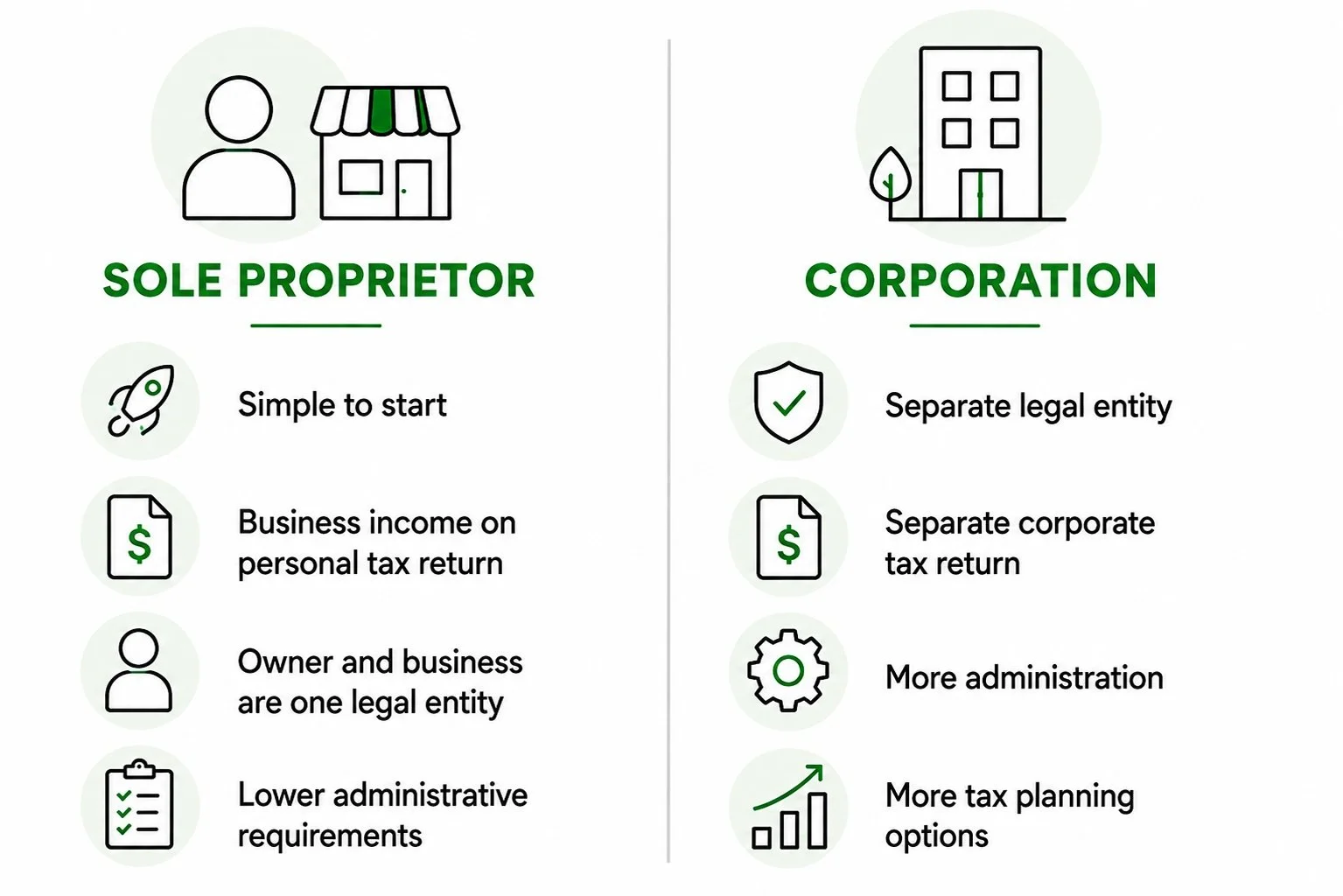
One of the first decisions you make when starting a business is how the business will be structured.
For many small business owners in British Columbia, the choice eventually comes down to two options:
Operate as a sole proprietor or incorporate.
Both structures can work well.
The important thing is understanding that incorporation isn't simply a more official version of being self-employed. It changes how the business is legally structured, how income is reported and how money moves between you and the business.
Here's a practical look at the differences.
What Is a Sole Proprietorship?
A sole proprietorship is the simplest form of business ownership.
You own and operate the business personally.
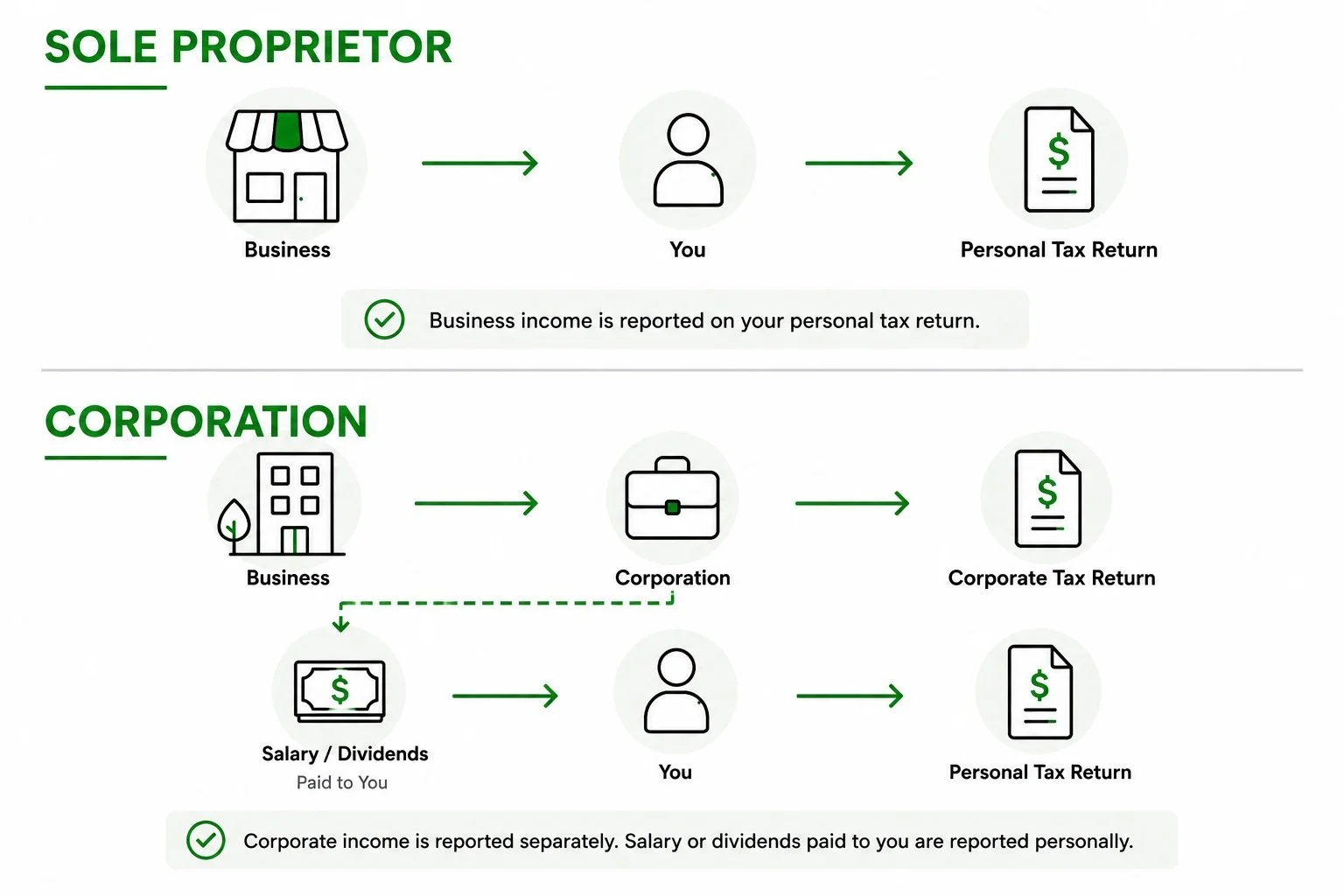
From a tax perspective, the business does not file a separate income tax return. The income and expenses from the business are reported as part of your personal income tax return.
If the business earns a profit, that profit generally becomes part of your personal taxable income.
This makes a sole proprietorship relatively straightforward to start and maintain.
What Is a Corporation?
A corporation is different because it is a separate legal entity.
Once incorporated, the corporation exists separately from you as the shareholder.
The corporation can earn income, own assets, borrow money, enter into contracts and incur expenses.
It also files its own corporate income tax return.
If you want to take money personally from the corporation, that needs to be accounted for appropriately, commonly through salary, dividends, repayment of amounts owing to you or other properly recorded transactions.
What Is the Biggest Difference?
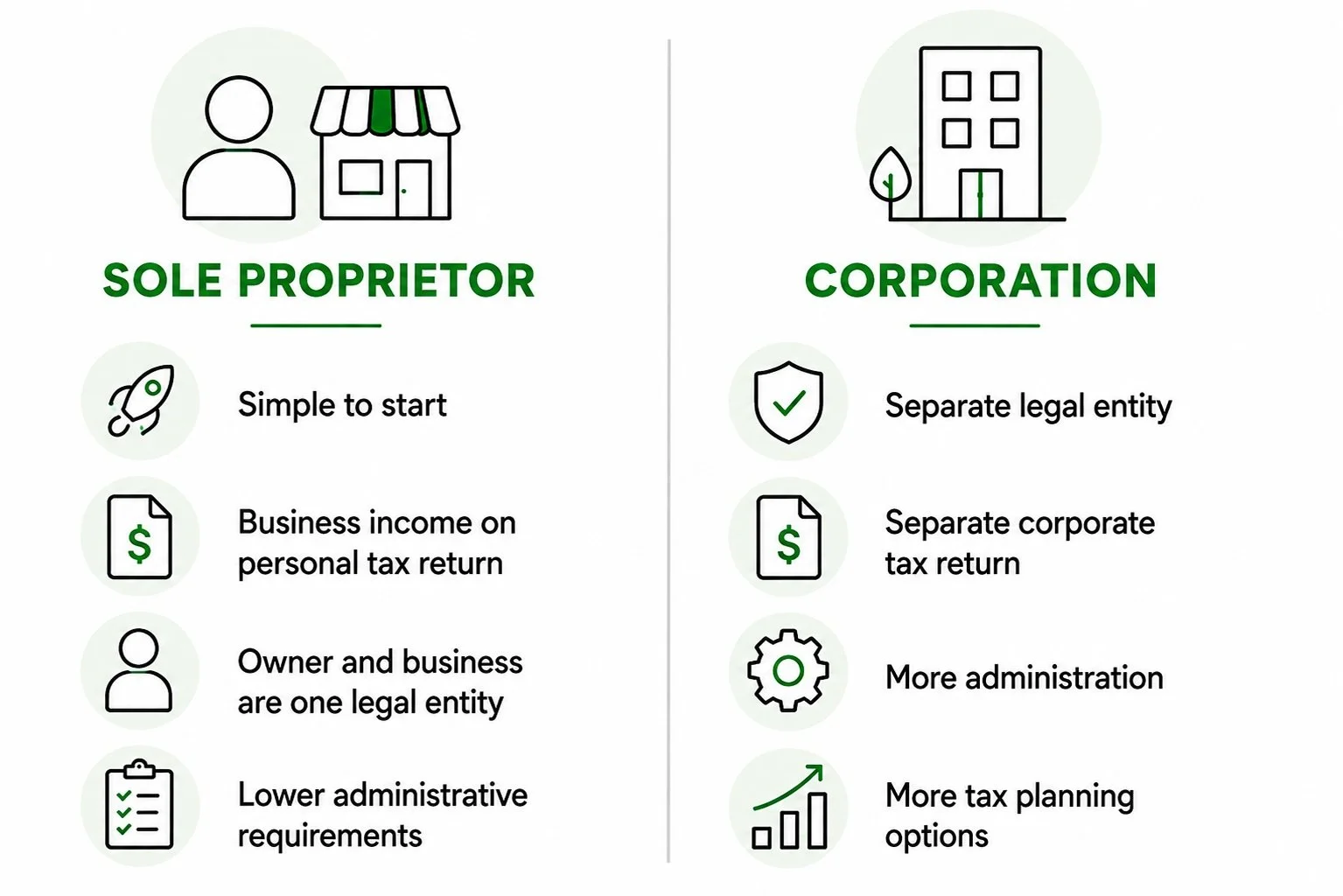
The biggest conceptual difference is separation.
With a sole proprietorship, you and the business are generally the same legal entity.
With a corporation, the corporation is a separate legal entity.
That distinction affects taxes, bookkeeping, administration, liability and how you take money out of the business.
Understanding that separation makes many of the other differences easier to understand.
How Are Sole Proprietors Taxed?
As a sole proprietor, your business income and expenses are reported on your personal income tax return.
If your business earns $100,000 in revenue and has $40,000 of deductible business expenses, the business has $60,000 of net income.
That $60,000 is generally included in your personal taxable income along with income you may have from other sources.
You don't pay yourself a salary or dividend from a sole proprietorship.
You can transfer money from the business account to your personal account, but that transfer itself isn't what determines your taxable income.
The profit of the business is what matters for income tax purposes.
How Is a Corporation Taxed?
A corporation files a separate corporate income tax return.
The corporation reports its revenue, expenses and taxable income and pays corporate income tax on its taxable income.
This creates an important distinction.
Money earned by the corporation belongs to the corporation until it is properly paid, distributed or otherwise transferred to you.
As the owner, you might receive money through:
Salary
Dividends
Reimbursement of business expenses
Repayment of money the corporation owes you
Each can have different accounting and tax consequences.
Does Incorporating Mean You Pay Less Tax?
Not automatically.
This is one of the biggest misconceptions about incorporation.
Corporations may have access to favourable corporate tax rates on qualifying business income, but that doesn't necessarily mean the owner ultimately pays less tax.
What matters is what happens to the money.
If you earn money inside the corporation and leave some of it there for future business use or investment, incorporation can sometimes provide opportunities to defer personal tax.
If you withdraw essentially all of the corporation's earnings personally every year, the tax advantage may be much smaller.
Salary and dividends are also taxed differently and have different implications.
That's why incorporation decisions shouldn't be based simply on hearing that the “corporate tax rate is lower.”
The entire situation matters.
Is a Corporation More Expensive to Maintain?
Generally, yes.
A corporation has additional administrative and accounting requirements.
These can include:
Incorporation costs
Annual corporate filings
Corporate bookkeeping
A separate corporate tax return
Payroll filings if salary is paid
Dividend documentation
Shareholder records
Corporate legal records
The exact costs depend on the business and how much professional support is required.
A sole proprietorship is generally less expensive and simpler to administer.
Is Bookkeeping Different for a Corporation?
The basic principles of bookkeeping are the same, but corporate bookkeeping usually requires more attention to how transactions involving the owner are recorded.
For example, if you use corporate funds to pay a personal expense, that isn't simply another business expense.
The transaction may need to be recorded through a shareholder account or treated another way depending on the circumstances.
Similarly, money you contribute personally to the corporation needs to be recorded properly.
This is one reason keeping business and personal spending separate becomes particularly important after incorporation.
What About GST?
Your business structure doesn't eliminate your GST obligations.
Both sole proprietors and corporations may need to register for GST depending on their taxable supplies and circumstances.
For most businesses, the small-supplier threshold is $30,000 in worldwide taxable supplies.
The timing of mandatory registration depends on how and when that threshold is exceeded.
Once registered, the business collects GST on applicable sales and may claim eligible input tax credits on business purchases.
The bookkeeping should track this throughout the year.
What About Liability Protection?
A corporation is a separate legal entity, which can provide a degree of separation between the business and its shareholders.
However, incorporation should not be viewed as complete protection from personal liability.
There are circumstances where directors or shareholders can still face personal liability, and business owners may also provide personal guarantees for loans, leases or other obligations.
The amount of liability protection that matters to your business depends heavily on what the business does.
Legal advice may be appropriate when liability is an important reason for considering incorporation.
When Does Incorporating Make Sense?
There isn't one revenue number at which every business should incorporate.
Instead, the decision usually depends on several factors.
Incorporation may become more attractive when:
The business is consistently profitable
You don't need to withdraw all the profits personally
You want to retain money inside the business
Liability is becoming more significant
The business is growing
You want more flexibility around compensation
There are longer-term tax or ownership considerations
But incorporation also brings additional costs and responsibilities.
For some businesses, remaining a sole proprietor is the simpler and better choice.
Should You Incorporate at $100,000 in Revenue?
Revenue alone isn't enough to answer the question.
A business generating $100,000 of revenue and $20,000 of profit is very different from one generating $100,000 of revenue and $80,000 of profit.
And even profit doesn't tell the whole story.
If you need all of the business income to pay your personal living expenses, the potential tax-deferral benefits of incorporation may be limited.
If the business generates more cash than you need personally, the calculation can change.
That's why profit, personal cash requirements and future plans are generally more useful than revenue alone when considering incorporation.
Can You Start as a Sole Proprietor and Incorporate Later?
Yes.
Many businesses begin as sole proprietorships and incorporate once the business becomes larger, more profitable or more complex.
You don't necessarily need to choose your permanent business structure on day one.
However, moving an existing business into a corporation can have accounting, tax and legal consequences, particularly if the business already owns significant assets or has accumulated value.
It's worth getting advice before making the transition.
Sole Proprietor or Corporation: Which Is Better?
Neither structure is inherently better.
A sole proprietorship offers simplicity.
A corporation offers separation and additional planning flexibility.
The right structure depends on your business, income, risks and plans.
The important thing is understanding what changes when you incorporate rather than assuming a corporation is automatically better because the business has reached a certain size.
Frequently Asked Questions
-
It depends on the business. Sole proprietorships are simpler and generally less expensive to maintain. Corporations provide a separate legal structure and can offer additional tax and compensation planning opportunities.
-
Corporations may qualify for lower corporate tax rates on certain business income, but that doesn't necessarily mean the owner pays less total tax. The result depends partly on how much money is retained in the corporation and how money is eventually paid to the owner.
-
No. A sole proprietor and the business are not separate taxpayers. Money withdrawn by the owner is generally considered an owner's draw rather than salary. The business's net income is reported on the owner's personal income tax return.
-
Yes. Many businesses incorporate after initially operating as sole proprietorships. Depending on the assets and circumstances of the business, professional accounting and legal advice may be appropriate when making the transition.
-
Yes. The corporation is a separate entity and should maintain its own accounting records, bank accounts and supporting documentation.
Bookkeeping, Accounting & Tax Support for Vancouver Businesses
At xBooks, we work with both sole proprietors and corporations throughout Vancouver and the Lower Mainland.
Our role goes beyond simply recording transactions.
We help keep the bookkeeping, accounting and tax sides of the business connected so that the financial records make sense throughout the year and are ready when it's time to file.
Whether you're operating as a sole proprietor, already incorporated or trying to understand what incorporation would mean for your business, we can help you understand the accounting side.
Need help with your bookkeeping, accounting or business taxes? Book a call with xBooks.